Google’s enforcement approach to repeat policy violations can escalate quickly—what starts as a warning can end with a full account suspension. John Horn of Search Engine Land explains the system and how advertisers can avoid losing ad access.
Why the three-strikes system matters
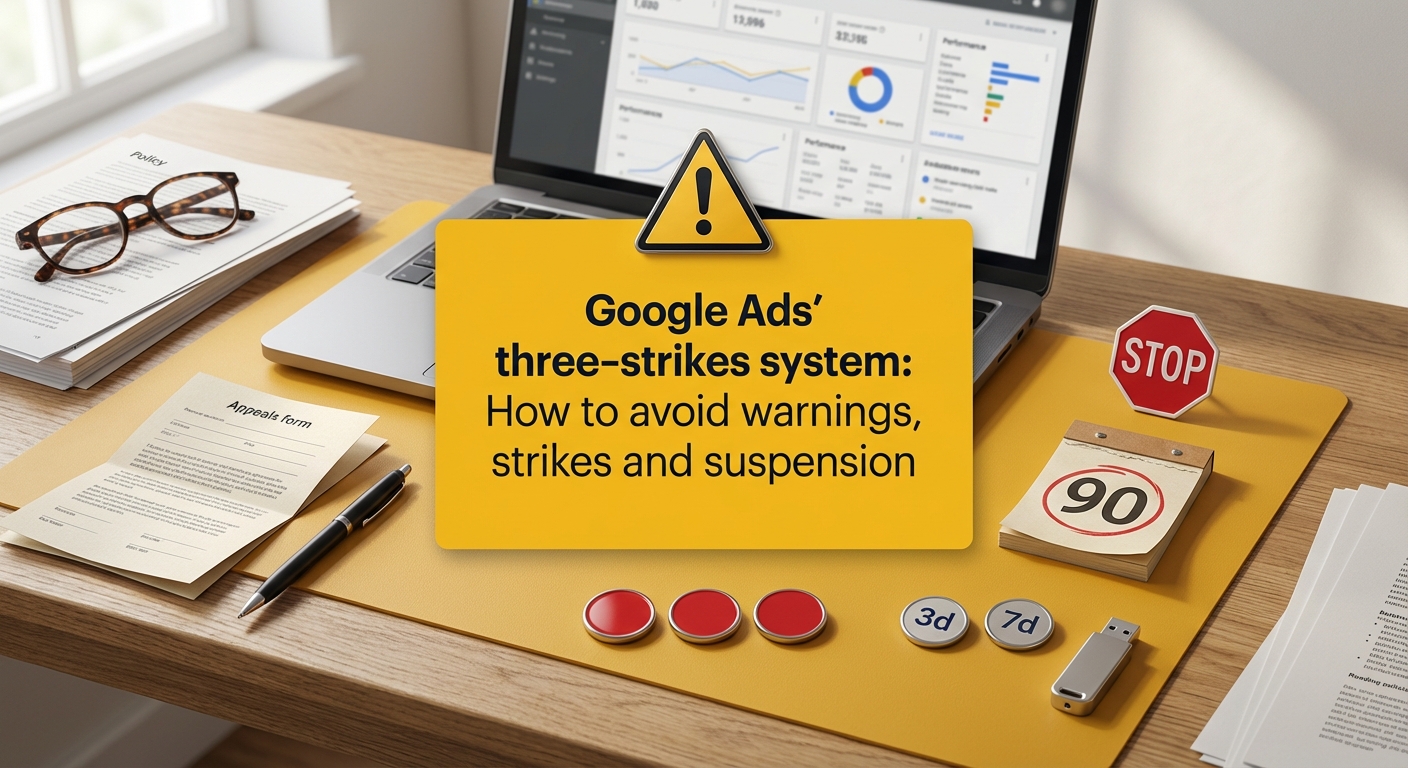
Google’s strikes policy targets repeat violations of a limited set of sensitive ad policies. As John Horn wrote, “Essentially, if Google decides your account has repeatedly violated any of 15 specific Google advertising policies, you’re at risk for temporary (and potentially permanent) suspension of your Google Ads account.” (John Horn, Search Engine Land, Mar 3, 2026). That escalation path — warning, strike one (three-day hold), strike two (seven-day hold), then suspension — means even small or accidental issues can quickly stop all ads for an advertiser.
How the system works
Google typically begins by issuing a warning, giving advertisers a chance to fix the problem while ads continue to run. If the same issue persists, strikes follow: an initial three-day hold for strike one, a seven-day hold for strike two, and a suspension on strike three. The clock matters: strikes and warnings are evaluated on a rolling 90-day window.
What Google officially says
Google’s own guidance underscores the progressive penalties. As Google Ads Help notes, “You will be able to receive a maximum of three strikes, and the penalties applied with each strike will progressively increase.” (Google Ads Help). That official guidance also documents the specific policy categories that trigger the three-strikes process and clarifies that other policy violations may lead to immediate suspension without the strike process.
Practical steps to prevent and respond to strikes
1. Audit policy-sensitive assets and old ads
Remove or update legacy ads, sitelinks, and image assets that may violate policy. Old assets can trigger strikes even if current campaigns are compliant.
2. Read the policies that apply to your vertical
Certain categories — like weapons, tobacco, financial services, and misleading ad design — have stricter enforcement. Review the relevant policy pages and align product pages, disclaimers, and ad creative to those rules.
3. Use clear, site-wide disclaimers where appropriate
John Horn’s case study with a ceremonial sword seller shows the power of explicit, site-wide language. When Google’s reviewers remain uncertain, a clear footer disclaimer visible on all pages can help human reviewers and automated systems understand intent and compliance.
4. Choose appeals strategically
Appealing a strike can restore ad serving if Google reverses the decision, but appeals often take 5+ business days and may fail. Acknowledging a strike is the fastest path back to ads but starts the 90-day clock toward potential suspension. Consider the business impact, the strength of your evidence, and the expected review time when deciding whether to appeal or acknowledge.
Implications for advertisers
First, take warnings seriously. Ignoring a warning is the most common path to accumulating strikes. Second, maintain documentation for every appeal and change you make; Google may not provide copies of your appeals after submission. Third, monitor your account’s strike history (Policy manager > Strike history) and track the 90-day windows so you know when a previous strike will expire.
Beyond immediate account health, the three-strikes system incentivizes over-compliance. In practice, that means advertisers should be prepared to make site-level changes, add extra contextual copy, and remove questionable creative rather than hoping an appeal succeeds.
Takeaway
Google’s three-strikes system is a blunt tool designed to deter repeat offenders, but it can catch legitimate advertisers who run afoul of nuanced policy interpretations. By proactively auditing assets, documenting appeals, and using clear site-wide messaging, advertisers can reduce the risk of an escalating enforcement response.
For the original reporting on this topic, see John Horn, “Google Ads’ three-strikes system: Managing warnings, strikes, and suspension,” Search Engine Land (Mar 3, 2026).
Further reading: Google Ads enforcement procedures for repeat violations — https://support.google.com/adspolicy/answer/10922738?hl=en-IE













.png)