For years, predictions about the end of SEO have surfaced whenever search evolves. Social media was expected to replace search, mobile was going to redefine it, voice search promised to change how people found information, and now artificial intelligence has fueled another wave of headlines suggesting that traditional search is becoming obsolete. While the technology continues to change, the underlying behavior has not. People still turn to digital platforms to answer questions, compare options, and make purchasing decisions.
The data tells a different story than many of the headlines. Search is not disappearing. It is expanding. Google has evolved far beyond a page of ten blue links, and AI has introduced new ways for people to discover information before they ever visit a website. These changes have altered how businesses earn attention, but they have not reduced the importance of being visible when customers are actively looking for answers.
At SEOteric, we wanted to understand how search has changed over the past fifteen years by looking beyond individual statistics or short-term trends. We analyzed research from Advanced Web Ranking, Sistrix, SparkToro, Similarweb, Gartner, HubSpot, Statista, and other respected industry sources to compare four long-term shifts that are shaping digital marketing: organic click-through rates, customer acquisition costs, search demand, and AI-powered search experiences.
Viewed independently, each trend tells an interesting story. Viewed together, they reveal something more significant. The opportunity to reach customers continues to grow, but earning their attention requires a broader approach than it did a decade ago. Search is no longer defined by rankings alone. It is increasingly defined by visibility across a connected ecosystem of search engines, AI assistants, local platforms, and authoritative digital content.
Executive Summary
Over the past fifteen years, search has become more competitive, more dynamic, and more fragmented. Google now answers many questions directly through AI Overviews, featured snippets, local results, shopping experiences, and other search features. At the same time, conversational AI platforms such as ChatGPT, Gemini, Claude, and Perplexity have become part of how people research products, services, and businesses.
Despite these changes, demand for information continues to grow. People are conducting more research before making decisions, using more platforms throughout the buying journey, and expecting immediate answers wherever they search. For businesses, the challenge is not declining demand. It is building authority across the growing number of places where customers seek information.
Our analysis identified several consistent trends. Organic click-through rates have declined as search results have become richer. Customer acquisition costs have steadily increased. Search demand continues to grow, while AI is expanding the ways customers discover information rather than replacing search entirely. Together, these trends suggest that digital visibility has become more valuable, not less.
The organizations that succeed over the next decade will not be those chasing individual algorithm updates. They will be the ones that consistently demonstrate expertise, authority, and trust wherever customers look for answers.
Ranking #1 Doesn’t Mean What It Used To
For many years, earning the first organic position on Google was one of the most valuable achievements in digital marketing. Around 2010, the top organic result received approximately 35 percent of all clicks, making it the primary destination for users searching for information. Businesses that earned and maintained that position often captured a significant share of the available traffic.
Today, the first organic result averages closer to 22 percent of clicks across many search types.
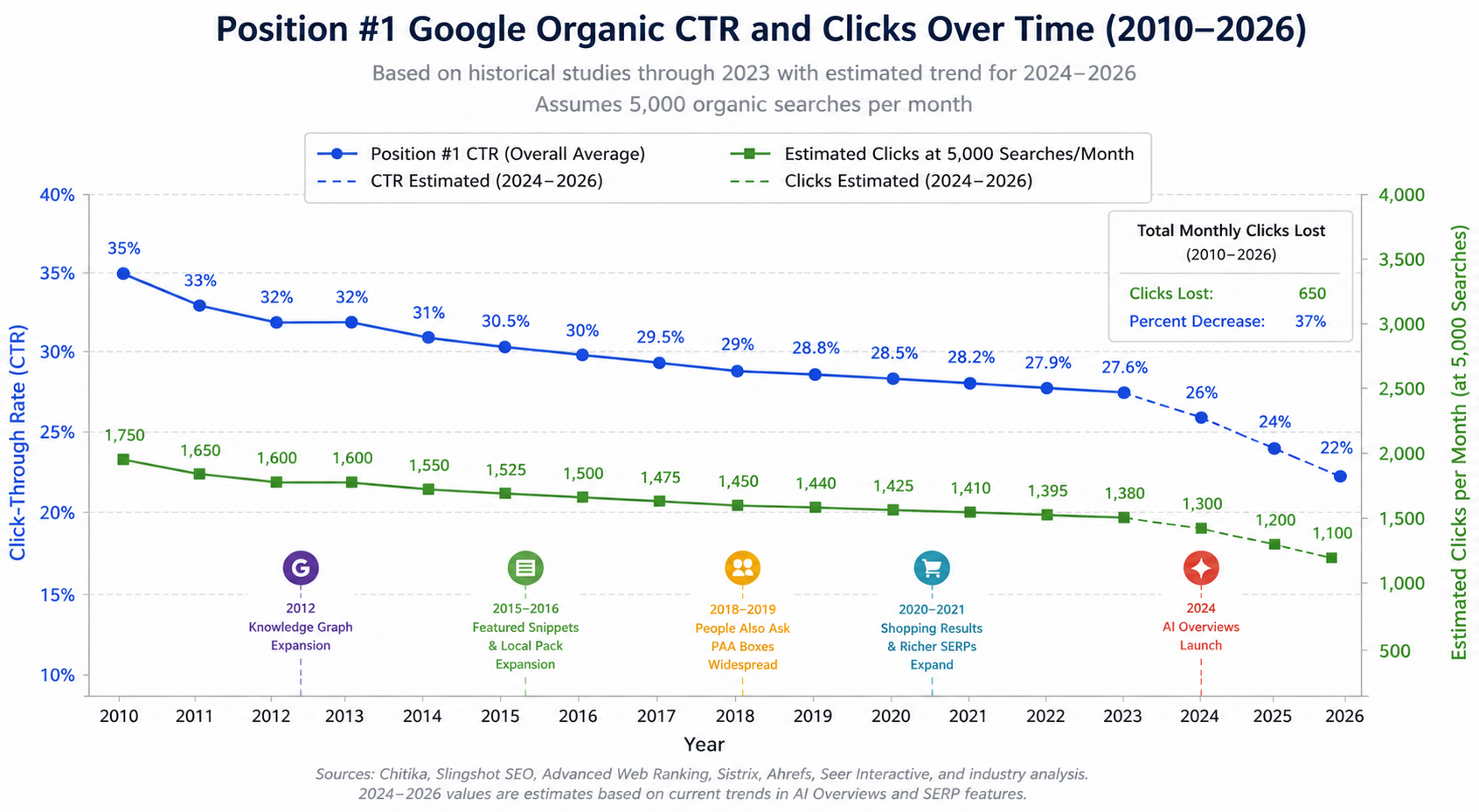
At first glance, this decline may suggest that organic search has become less valuable. In reality, it reflects how dramatically Google’s search experience has evolved. Modern search results frequently include AI Overviews, featured snippets, local map listings, shopping results, videos, images, knowledge panels, and People Also Ask sections before users ever reach the traditional organic listings. Search engines now answer many questions directly, reducing the percentage of clicks any single result receives.
This shift does not mean ranking first is less important. It means ranking first is no longer the only measure of success. Businesses must now compete for visibility across a broader search experience, where customers interact with multiple sources before making a decision. The objective has shifted from winning a single ranking to becoming a trusted source throughout the customer’s research process.
Customer Acquisition Costs Continue to Rise
While organic click-through rates have gradually declined, another long-term trend has moved in the opposite direction. Customer acquisition has become steadily more expensive as competition for digital attention has increased.
Our analysis of historical marketing benchmarks found that average customer acquisition costs have increased from roughly $95 in 2010 to more than $240 today, with many industries experiencing significantly higher costs.
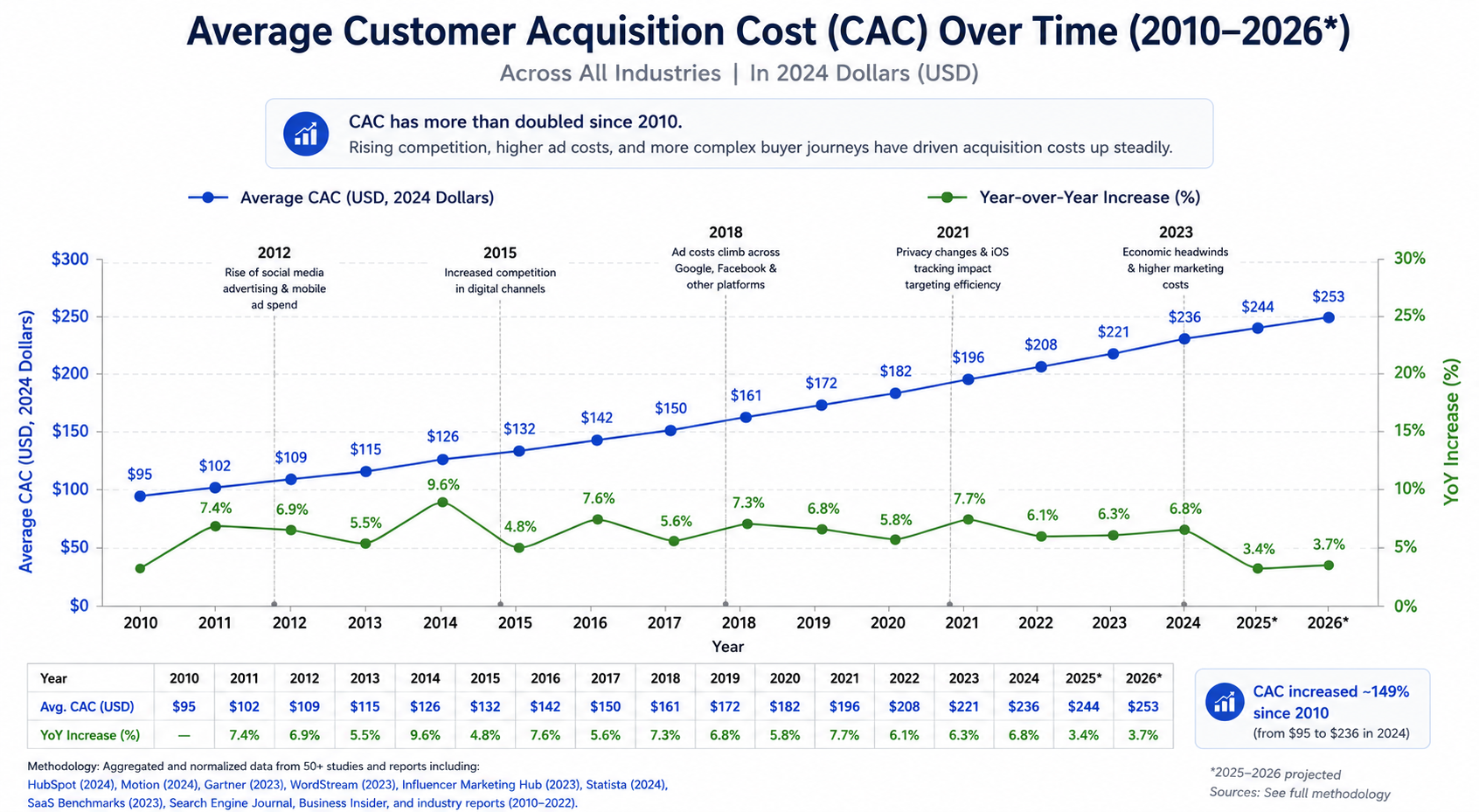
Several factors have contributed to this trend. More businesses compete for the same audiences through digital advertising, increasing costs across auction-based platforms. Privacy changes have reduced the precision of audience targeting, while consumers typically spend more time researching purchases across multiple websites and platforms before making a decision. The result is that acquiring a new customer often requires a larger investment than it did a decade ago.
This changes how businesses should evaluate organic search. Although a number one ranking generates fewer clicks than it once did, every qualified visitor represents traffic that might otherwise require paid advertising to acquire. As acquisition costs continue to increase, strong organic visibility becomes more than a traffic strategy. It becomes an important contributor to long-term marketing efficiency.
Search Demand Continues to Grow
The decline in organic click-through rates is sometimes interpreted as evidence that search itself is becoming less important. The broader data suggests the opposite. Google continues to process trillions of searches each year, while AI assistants have introduced entirely new ways for people to research products, services, and businesses.
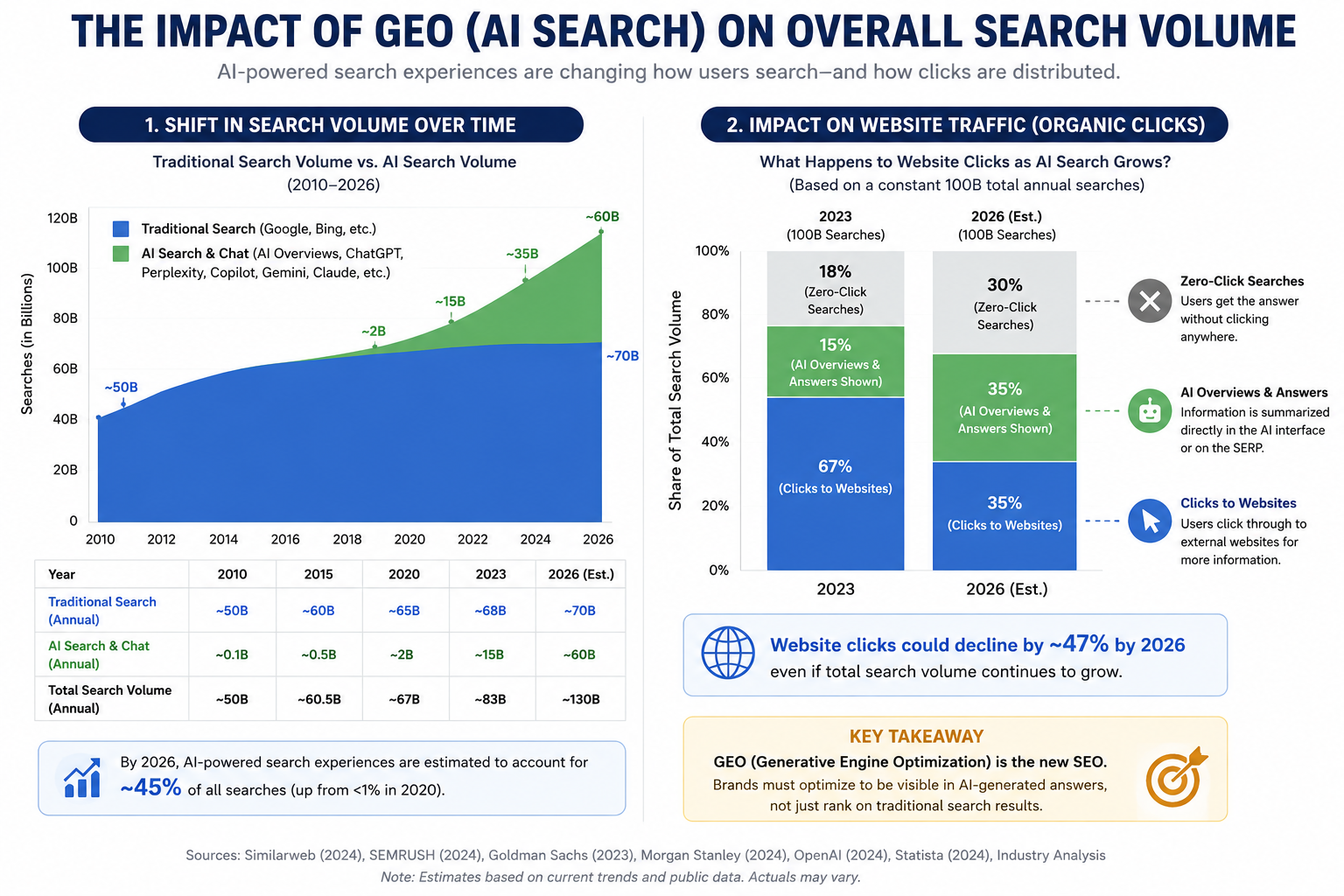
Today’s customers rarely make purchasing decisions after a single search. They compare reviews, ask AI assistants for recommendations, watch videos, verify business information, and evaluate alternatives before contacting a company. The buying journey has become more informed and involves more digital touchpoints than ever before.
For businesses, this creates both opportunity and responsibility. There are more opportunities to influence buying decisions throughout the customer journey, but success depends on establishing credibility across more platforms than ever before. Search is no longer a single destination. It is an ecosystem of discovery where customers gather information from traditional search, AI platforms, maps, reviews, videos, and trusted publications before choosing who to do business with.
The question is no longer whether people are searching. The question is whether your business is visible wherever they choose to look.
Where Did the Clicks Go?
One of the most common questions businesses ask is, “If organic click-through rates have declined, where did those clicks go?”
They didn’t disappear. They were redistributed across a much broader search experience.
Fifteen years ago, a typical Google results page contained a few advertisements followed by ten organic listings. If users wanted an answer, they usually clicked through to a website. Today, a single search may include AI Overviews, featured snippets, local business profiles, shopping results, videos, images, knowledge panels, and People Also Ask sections before the first organic listing is even visible.
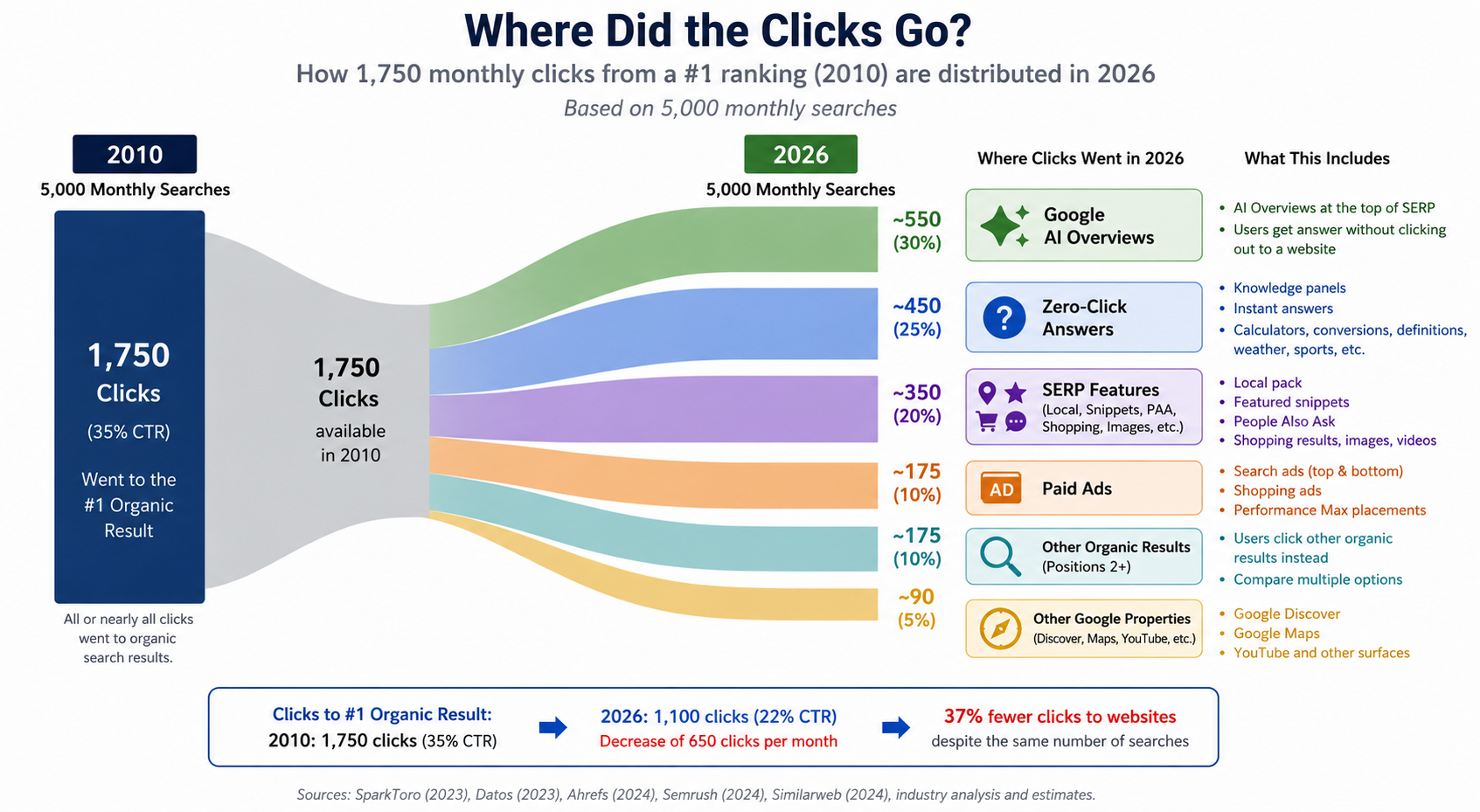
This evolution has changed how people interact with search. Many users can answer simple questions without leaving the results page, while others use Google’s search features to narrow their options before visiting a website. For more complex decisions, AI assistants often become another step in the research process, helping users compare products, understand terminology, or identify potential vendors before they continue their search.
What has not changed is the role of authoritative content.
Search engines and AI platforms still depend on high-quality websites to answer questions. AI Overviews cite trusted sources. Featured snippets are extracted from well-structured pages. Local search relies on accurate business information, reviews, and citations. Even large language models depend on information published across the web to understand businesses, industries, and topics.
The website remains the foundation of digital visibility. What has changed is the number of ways that information can be surfaced before someone visits it.
For businesses, this represents a shift in strategy rather than a loss of opportunity. Instead of asking, “How do we rank for this keyword?” organizations should also ask, “How do we become a trusted source wherever customers are looking for answers?” That requires a broader approach to digital marketing than rankings alone can provide.
Digital Visibility Is the New Competitive Advantage
The evolution of search has expanded the role of SEO rather than reduced it.
Traditional SEO remains essential because it provides the technical foundation that helps search engines discover, understand, and rank content. Site architecture, page performance, internal linking, structured content, and technical optimization continue to influence how information is indexed and presented.
What has changed is the number of signals that contribute to visibility.
Today’s search ecosystem rewards businesses that consistently demonstrate expertise and authority across multiple channels. Search engines evaluate content quality, brand reputation, third-party references, structured data, reviews, local signals, and many other indicators to determine which businesses deserve visibility. AI platforms rely on many of these same signals when generating responses and recommending sources.
This convergence has given rise to new terms such as Generative Engine Optimization (GEO). While the name is new, many of the underlying principles are familiar. Creating comprehensive content, publishing original insights, earning authoritative mentions, implementing structured data, and maintaining accurate business information have long been considered best practices. Those same activities now improve visibility across both traditional search and AI-powered experiences.
Rather than replacing SEO, GEO extends it. The goal is no longer limited to ranking webpages. It is helping search engines and AI systems understand who your organization is, what it does, and why it should be considered a trusted source.
At SEOteric, we view these disciplines as parts of a single strategy rather than separate services. Technical SEO, content strategy, digital PR, local optimization, structured data, and AI visibility all reinforce one another. Together they build a stronger digital presence than any individual tactic can achieve on its own.
Measuring Success in a Changing Search Landscape
As search evolves, businesses should also reconsider how they measure success.
Website traffic remains an important performance indicator, but it no longer captures every meaningful interaction. A prospective customer may first discover your business through an AI-generated answer, compare reviews, explore your Google Business Profile, read an industry publication, and only later visit your website to request a quote or schedule a consultation. Every one of those touchpoints contributes to the buying decision.
A broader view of performance should include traditional SEO metrics alongside indicators that reflect overall visibility and authority. Organic traffic, qualified leads, branded search volume, local search engagement, authoritative mentions, and customer acquisition costs together provide a more complete picture of how effectively a business is reaching its audience.
This perspective also encourages longer-term thinking. Rankings fluctuate, algorithms change, and new technologies continue to emerge. Businesses that invest in becoming recognized authorities are better positioned to adapt because their visibility is built on trust rather than any single search feature or platform.
Digital marketing has always been about helping customers find trustworthy businesses when they need them. That objective has not changed. The number of places where those discovery moments occur has.
Bringing the Trends Together
Each of the trends we’ve examined tells an important story. Organic click-through rates have gradually declined as search results have become richer and more interactive. Customer acquisition costs have steadily increased as competition for digital attention has grown. Search demand continues to expand, while AI has introduced new ways for people to research businesses before making a decision.
Viewed together, these trends reveal a larger shift in digital marketing.
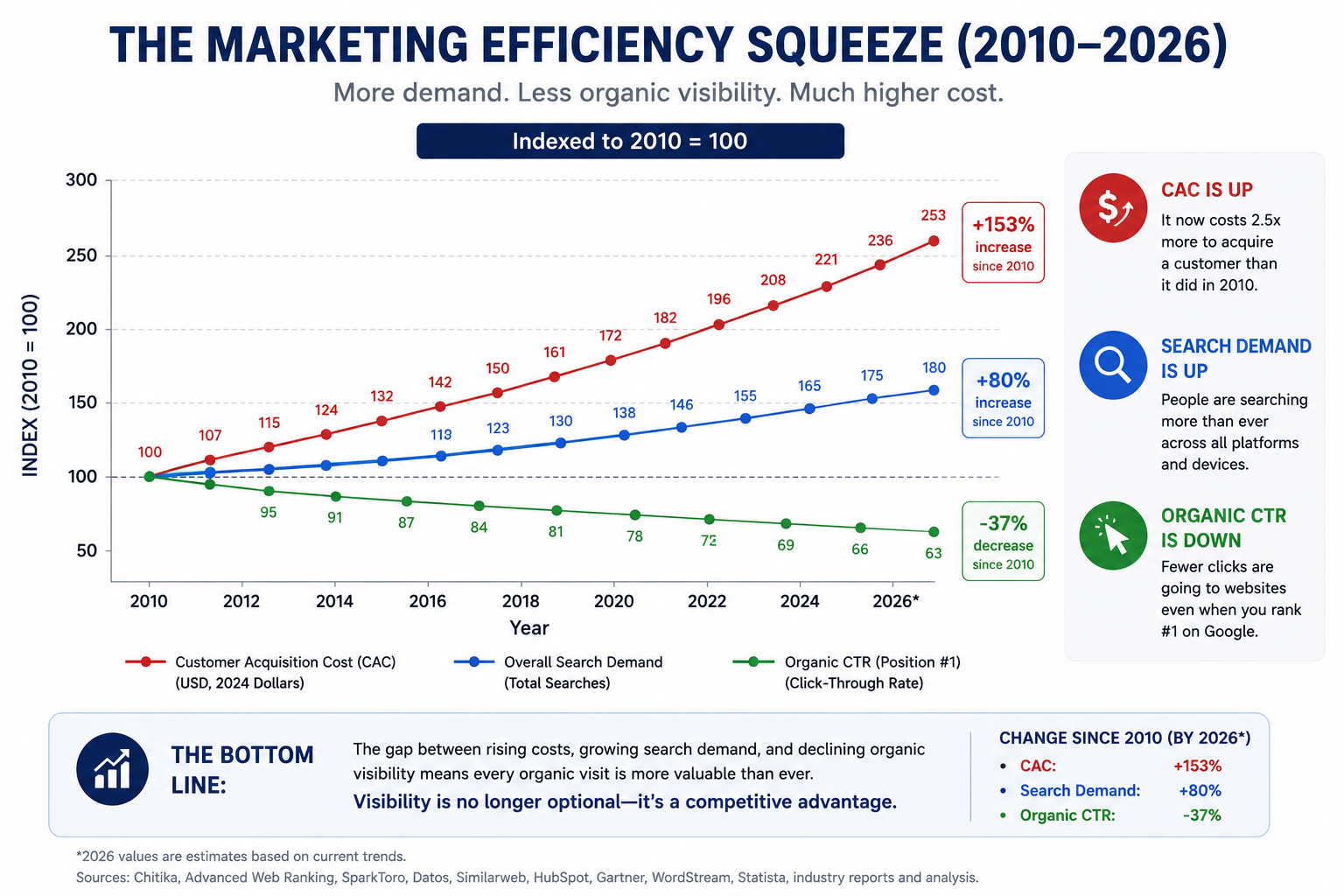
The chart illustrates three long-term movements occurring at the same time:
- Search demand continues to increase.
- Customer acquisition costs continue to increase.
- Organic click-through rates continue to decline.
At first, these trends may seem contradictory. If businesses receive a smaller percentage of clicks from search results, it would be easy to conclude that SEO has become less valuable. However, the rising cost of customer acquisition changes that equation.
Every qualified visitor earned organically represents traffic that may otherwise require paid advertising to acquire. As acquisition costs increase, each organic visit carries greater economic value. The result is that visibility becomes more important, even as the percentage of available clicks becomes smaller.
The opportunity has not diminished. The way businesses compete for that opportunity has changed.
Organizations that rely exclusively on paid advertising may find customer acquisition becoming progressively more expensive over time. Organizations that invest in technical SEO, authoritative content, digital PR, local search, and brand authority are building assets that continue generating visibility long after they are created.
This is one of the reasons we believe businesses should evaluate search as a long-term investment rather than a short-term traffic channel. Rankings fluctuate, algorithms evolve, and search interfaces change, but organizations that consistently demonstrate expertise and authority are well positioned regardless of how customers discover information.
What Businesses Should Do Next
Although search will continue to evolve, the fundamentals of building visibility remain remarkably consistent. Businesses that create trustworthy, useful, and authoritative information continue to outperform those focused primarily on short-term optimization tactics.
For most organizations, the priorities are clear.
Continue investing in a technically sound website that search engines and AI systems can easily understand. Publish original content that demonstrates expertise instead of simply targeting keywords. Strengthen your brand through digital PR, customer reviews, partnerships, and authoritative industry mentions. Implement structured data so search engines can better understand your products, services, and organization. Finally, measure success through business outcomes such as qualified leads, customer acquisition costs, and overall visibility rather than rankings alone.
These practices improve performance across traditional search while also strengthening visibility within AI-powered search experiences.
Technology will continue to change. The principles of earning trust will not.
The Future of Search
The phrase “search engine optimization” no longer captures the full scope of what businesses need to accomplish online.
Customers rarely rely on a single source before making a decision. They move between search engines, AI assistants, maps, reviews, social platforms, videos, and industry publications as they gather information and evaluate providers. Every interaction shapes their perception of a business.
The organizations that succeed in this environment will not be those that optimize for a single algorithm. They will be the ones that consistently provide accurate information, demonstrate expertise, and build authority across the digital ecosystem. Whether a customer begins with Google, ChatGPT, Gemini, Claude, Perplexity, or another platform matters less than whether they encounter a business they trust.
That is why we believe the future of SEO is broader than rankings. It is about helping businesses become visible wherever customers seek answers and ensuring that every digital touchpoint reinforces credibility and confidence.
The tools will continue to evolve. AI will improve. Search interfaces will change. New platforms will emerge.
Trust, authority, and visibility will remain the foundation of digital marketing.
Methodology & Sources
This analysis combines findings from multiple independent studies and industry reports to examine long-term changes in digital marketing. Rather than relying on a single dataset, we compared published research from several respected organizations to identify consistent trends across organic search, customer acquisition, and changing search behavior.
Where long-term historical data was available, it was used directly. In cases where no single source tracked a metric over the full fifteen-year period, multiple published studies were combined to illustrate the overall direction of the market. As a result, some charts represent synthesized trend lines designed to show long-term movement rather than exact historical measurements for every year.
The objective of this article is not to establish universal benchmarks. Every industry, market, and business experiences different results. Instead, these charts provide context for understanding how search has evolved and why businesses should think differently about digital visibility as search engines and AI platforms continue to develop.
Selected Sources
This article was informed by research and reporting from:
- Advanced Web Ranking
- Sistrix
- SparkToro
- Datos
- Similarweb
- HubSpot
- Gartner
- Statista
- Search Engine Journal
- Search Engine Land
- Backlinko
- Chitika
- Optify
- Slingshot SEO
About SEOteric
For more than two decades, SEOteric has helped businesses improve their digital visibility through technical SEO, content strategy, local search optimization, digital PR, analytics, paid media, and emerging AI search strategies.
Search will continue to evolve, but the objective remains the same: helping businesses become more discoverable, build greater authority, and connect with customers at the moments that matter most.
Whether those customers begin their journey with Google, an AI assistant, a local search, or a platform that has yet to emerge, organizations that invest in trust and authority will be best positioned for long-term success.









.png)